Total Solar Eclipse 2027 in Egypt — Astronomy, History, and Cultural Significance
On August 2, 2027, one of the most remarkable astronomical events of the 21st century will occur: a Total Solar Eclipse crossing North Africa and reaching its maximum duration over Egypt, particularly near Luxor. With totality exceeding six minutes in certain locations, this eclipse stands among the longest observable from land in modern times. Such rare celestial alignments have historically shaped human perception of the cosmos, influencing science, religion, and political structures across civilizations.
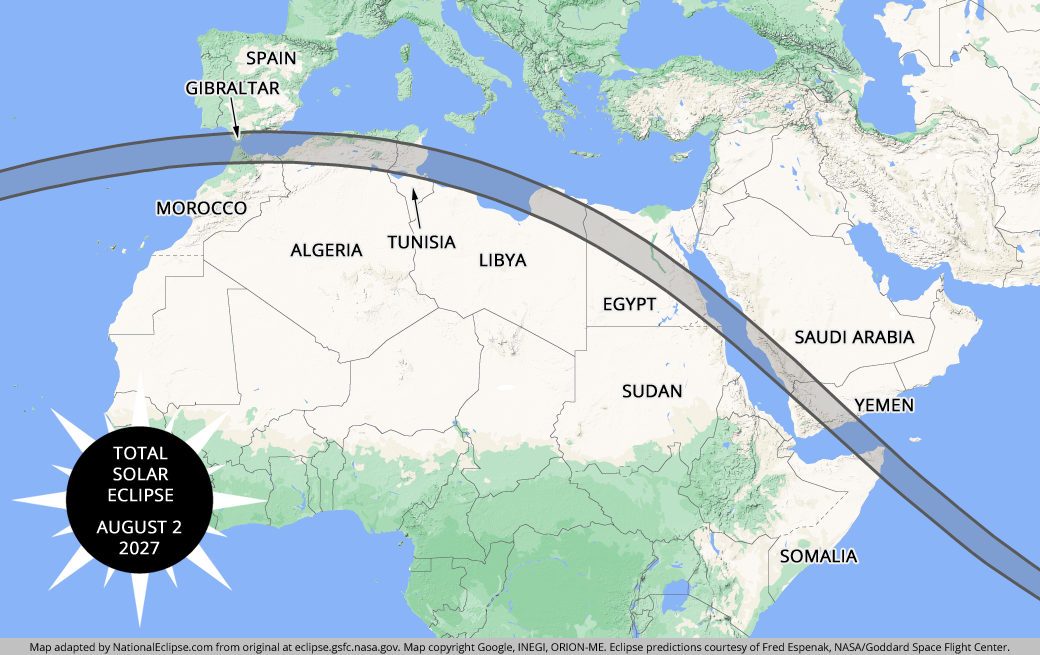
Image credit: NationalEclipse.com
Astronomical Context and Scientific Importance
A total solar eclipse occurs when the Moon passes directly between the Earth and the Sun, completely obscuring the solar disk for observers located within the path of totality. This phenomenon is not only visually striking but also scientifically significant. During totality, the Sun’s corona becomes visible, allowing researchers to study solar plasma dynamics, magnetic fields, and energy emissions otherwise hidden by the intense brightness of the photosphere.
The 2027 eclipse is exceptional due to its duration and geographic accessibility. Egypt offers some of the most stable atmospheric conditions for observation, characterized by low humidity, minimal cloud cover, and high solar visibility. These factors combine to create optimal conditions for both scientific observation and experiential engagement.
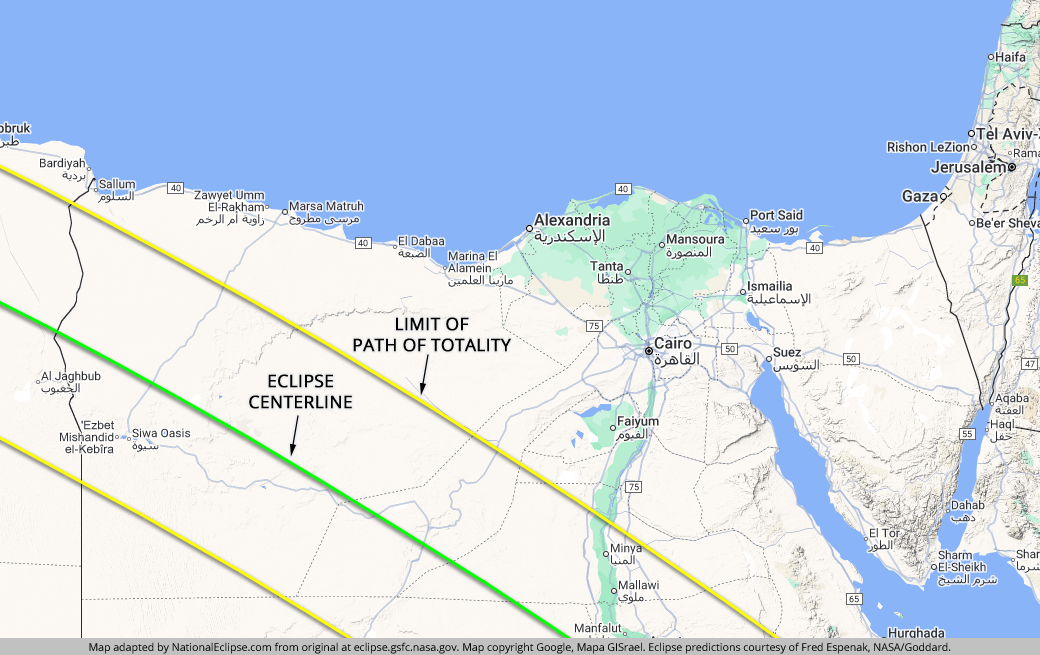
Image credit: NationalEclipse.com
Egypt and the Path of Totality
The path of totality crosses Egypt from northwest to southeast, intersecting regions of profound historical and cultural significance. Luxor, located near the ancient city of Thebes, lies close to the centerline, offering one of the longest durations of totality available anywhere on Earth for this event. This convergence between celestial alignment and historical geography creates a uniquely powerful setting.
Ancient Egyptian civilization was deeply attuned to celestial cycles. Solar movements, in particular, were central to religious belief systems and architectural alignments. Temples such as Karnak and Abu Simbel demonstrate precise solar orientation, suggesting a sophisticated understanding of astronomical patterns. While eclipses were less predictable within their cosmological framework, their sudden occurrence would have been perceived as extraordinary disruptions of cosmic order.
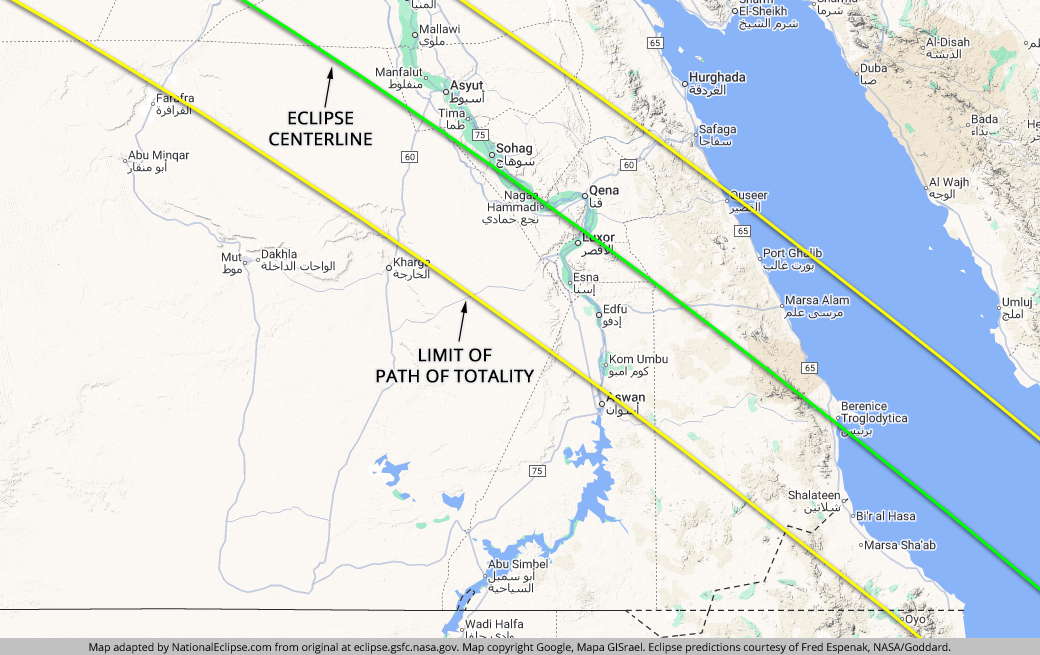
Image credit: NationalEclipse.com
Solar Eclipses in Ancient Perception
In many ancient cultures, solar eclipses were interpreted as omens or manifestations of divine intervention. Within the Egyptian worldview, the Sun was not merely a celestial body but a central divine entity, represented by Ra and later reinterpreted through theological transformations such as Atenism under Pharaoh Akhenaten.
An unexpected obscuration of the Sun could have been perceived as a moment of cosmic instability or divine withdrawal. While direct textual evidence from Ancient Egypt explicitly describing solar eclipses is scarce, comparative studies with neighboring civilizations suggest that such events were likely regarded with profound symbolic weight.
The Akhenaten Hypothesis — Eclipse and Political Transformation
One of the most intriguing theoretical interpretations in archaeoastronomy concerns the possible relationship between a solar eclipse and the end of the reign of Pharaoh Akhenaten (14th century BCE). Akhenaten is known for his radical religious reform, which elevated Aten—the solar disk—as the central and near-exclusive deity of Egyptian worship.
This theological shift represented a dramatic departure from traditional polytheistic structures. However, the abrupt decline of Atenism following Akhenaten’s death remains a subject of ongoing scholarly debate. Some researchers have proposed that a significant solar anomaly—potentially a total eclipse—may have played a symbolic or psychological role in undermining the perceived divine stability of Aten.
While this hypothesis remains speculative and is not universally accepted within academic Egyptology, it provides a compelling framework for considering how rare astronomical events might intersect with sociopolitical transformations. A sudden darkening of the Sun—central to Akhenaten’s theology—could have been interpreted as a profound contradiction of divine order, thereby accelerating religious and political realignment.
A Contemporary Convergence
The Total Solar Eclipse of 2027 offers more than an observational opportunity; it represents a convergence of science, history, and cultural interpretation. Observing this phenomenon in Egypt—within landscapes shaped by millennia of solar reverence—invites a deeper reflection on humanity’s enduring relationship with the cosmos.
In this context, the eclipse becomes not only a scientific event but also a cultural and philosophical moment. It bridges ancient symbolic systems with modern astrophysical understanding, allowing for a multidimensional experience that extends beyond traditional tourism or isolated scientific observation.
The Egypt Convergence Platform emerges within this framework as an initiative designed to explore precisely this intersection. By integrating visual art, intellectual discourse, and site-specific presence, it seeks to reinterpret the eclipse as a catalyst for contemporary cultural production and global dialogue.